Showing posts with label Cambodia. Show all posts

Wednesday, June 17, 2009

Amok Chicken, Siem Reap, Cambodia


Taken with Nikon D60, dated May 2009


Amok is a popular Cambodian dish. The amok dish can be cooked with fish, chicken, pork or beef, but some used shrimp. The main ingredients are coconut milk and turmeric which are essential to the dish. It is usually eaten with rice.

I tried the amok chicken at food stall in Angkor Thom. It was really tasty. The boneless chicken breasts, egg and their local vegetable, it all blended well together. You can feel the spices and spicy recipes, but with a much milder taste. I like its soup, especially the betel leaves taste had in the soup, and it was very yummy. 3-4USD per dish.

I also have the amok fish which serve in a coconut shell in the next day. It tasted like otak-otak to me.

Thursday, May 28, 2009

Garuda, Preah Khan, Cambodia


Taken with Nikon D60, dated May 2009


Garuda is a hulking man-bird most commonly depicted as defeating serpents of various sizes or serving as a battle steed to the god Vishnu, either in his divine form or in his incarnate form as Krishna. The Angkorian art has inspired by Hindu mythology, there are impressive Angkorian depictions of Garuda include the haut relief sculptures on the city walls of Preah Khan, and the bas relief murals of Angkor Wat.

Apsara, Angkor Wat, Cambodia


Taken with Nikon D60, dated May 2009


Apsara is a female spirit of the clouds and waters in Hindu and Buddhist mythology. They appears as young women of great beauty and elegance who are proficient in the art of dancing. English translation of the word "Apsara" is nymph or celestial nymph. Carved in abundance on many of the Angkorian temples.

Wednesday, May 27, 2009

Kbal Spean, Siem Reap, Cambodia


Taken with Nikon D60, dated May 2009

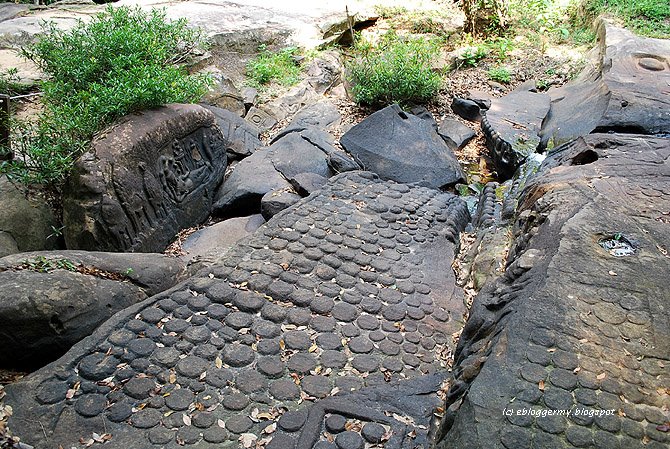
Kbal Spean is well known with its spectacularly carved riverbed which set in the forested mountain, Kulen Mountain. Kbal Spean is about 12 kilometers past Banteay Srey. From the parking area, it was a 1500 meter hike through the jungle, about 45 minutes to the carved area. While most of the walk is a gentle slope uphill, there are two rough spots that require some steep climbs.


Taken with Nikon D60, dated May 2009

Kbal Spean actually means "The Bridgehead". It is commonly known as the river of 1000 lingas due to the presence of the estimated one thousand lingas on the riverbed. The linga is a simple phallic shape, the symbol of the God Shiva and his powers of creation. Its riverbanks are also dotted with sculpted stone lingas on the pedestals. Big brown rocks around the river and the waterfall are carved of Buddha and Hindu deities. Those images of various gods and sacred lingas are carved into the rocks of the riverbed is said to fertilize the water. The water flowing down the river would thus be blessed by the carvings before coursing on to Angkor.

Tuesday, May 26, 2009

Gecko, Angkor Wat, Cambodia


Taken with Nikon D60, dated May 2009


When I about to touch the carving stone, I found a gecko underneath its outcrop. The body colour of this creature is totally blend in with the rock colour, if I did not noticed and for sure I will miss it.

Geckos are small-medium sized lizards belonging to the family Gekkonidae and found in warm climates throughout the world. Geckos are unique among lizards in their vocalizations, making chirping sounds in social interactions with other geckos. Males also use the voice to establish dominance of a particular area or to attract females.

Geckos live on rocky outcrops or in trees. They are superb climbers, and many species have small toe pads made up of tiny hairlike scales that enables them to climb vertically or upside down. Most species are nocturnal and have eyes with vertical, slitlike pupils that can be expanded to accommodate darkness and let in more light. Geckos come in various colours and patterns. Some are subtly patterned and somewhat rubbery looking, while others can be brightly colored. Some species can change color to blend in with their environment or with particular temperatures.

Friday, May 22, 2009

Preah Neak Pean, Siem Reap, Cambodia


Taken with Nikon D60, dated May 2009

Neak Pean means Intertwined Serpent (Naga). It was late 12th century Buddhist temple constructed by Jayavarman VII. Neak Pean is quite different. it has a large square pool with four smaller square pools arranged on each axis. In the centre of the central pool is a circular 'island' encircled by the two naga whose intertwined tails give the temple its name.


Taken with Nikon D60, dated May 2009

In the pool around the central is island, there were once four statues, but only one remains, reconstructed from the debris by the French archaeologists who cleared the site. The statue has the body of a horse with four human legs. It relates to a legend that Avalokiteshvara once saved a group of shipwrecked followers from an island of ghouls by transforming himself into a flying horse. There are four ornamental water spouts from the central pool to the four smaller ones. The spouts are in the form of a head of elephant, horse, lion and human. The pool was used for ritual purification rites.

Preah Khan, Siem Reap, Cambodia


Taken with Nikon D60, dated May 2009

Preah Khan means "Sacred Sword", it was built in 1191 during the reign of King Jayavarman VII and dedicated to his father, Dharnindravarman II. There is a causeway lead to the temple are bordered by the stone statues carrying a long nine-headed Naga (sacred cobra) symbolized the Churning the Sea of Milk.


Taken with Nikon D60, dated May 2009

This complex includes a set of four concentric enclosures are longer to the east and west, 800m by 700m, 7m high, a giant sandstone Garudas decorated and spaced at 50m intervals around the enclosure. The garuda is a mythical bird-man, vehicle of Vishu and enemy of the nagas. This giant figure has clawed hands and feet and holds the tail of a naga in each hand.


Taken with Nikon D60, dated May 2009

Preah Khan like most of Jayavarman VII's monuments, and it was Buddhist university, a temple, a kind of monastery, and a city. Much has not been restored at this site, in fact, masonry clutters many of the courtyards, making some exploration hazardous.

Sunday, May 17, 2009

The Terrace of the Elephants, Angkor Thom, Siem Reap, Cambodia


Taken with Nikon D60, dated May 2009

Terrace of the Elephants is located in the Royal Square of Angkor Thom and attached to the palace of Phimeanakas, of which only a few ruins remain. The Terrace of Elephants with length of 350 meters long terrace, two and a half-meter tall which is adorned with carved elephants, garudas (mythical man-bird figures), five-headed horse and other figures. Many lions decorate this enormous path. At the south stairway, there are three-headed elephant with trunks forming pillars tugging at lotuses. The terrace is named for the carvings of elephants on its eastern face.


Taken with Nikon D60, dated May 2009

The Terrace of the Elephants was used by Angkor's king Jayavarman VII for his public address, royal ceremonies, and also as a platform to view his victorious returning army.

Prasat Kravan, Sieam Reap, Cambodia


Taken with Nikon D60, dated May 2009


Prasat Kravan is located in the east of Angkor Wat and south of Banteay Kdei. Built by King Harshavarman I in the early 10th century during his reign and was dedicated to Hinduism. Prasat Kravan is an unique arrangement of five brick towers in a row on one terrace. The lintels and columns are of sandstone. The sanctuaries inside the towers are remarkable for the large bas-relief depictions of Vishnu and Lakshmi that have been carved into the walls of reddish brick.

Prasat Kravan was reconstructed by archaeologists in the early 20th century. Some broken bricks were replaced with carefully made reproductions which are marked with the letters "CA".

The Gateways & The Causeways, Angkor Thom, Siem Reap, Cambodia


Taken with Nikon D60, dated May 2009

Angkor Thom ("Great City"), the capital of Jayavarman VII, is an ancient Khmer city just north of Angkor Wat. The city is quadrangular in shape, walled and surrounded by a gigantic moat. There are five causeways that leads to gates or entrance of the city, one for each cardinal point namely North, South, East, West and the final gate named Victory Gate leading to the Royal Palace area. The exquisitely decorated gateways are 75 feet high and are wide enough to allow procession of elephants to pass through. On the top of gateway has four giant faces of the Bodhisattva, Avolokitesvara in the four cardinal direction. At the base, on both sides of the gate are stone three-headed elephants who plucks lotus flowers with his trunks.


Taken with Nikon D60, dated May 2009

The causeways have a row of torsos of 54 Devas ("guardian gods) on the left and 54 Asuras ("demons god") on the right, each group is holding a huge naga (multi-headed snakes) in the attitude of a tug-of-war. The posture here is apparently a reference to the popular myth of Angkor, the Churning of the Sea of Milk, which is also depicted in Angkor Wat. In this myth, the Devas pulled the snake in one direction and the gods pushed in the other, the ocean began to churn and precipitate the elements. By alternating back and forth, the ocean was "milked", forming the earth and the cosmos anew.

Friday, May 15, 2009

Srah Srang, Siem Reap, Cambodia


Taken with Nikon D60, dated May 2009


Srah Srang means the Royal Bath, is a large lake, about 700 by 400 meters with an elegant landing terrace. Naga balustrades end in upright nagas, each one a snake with three heads mounted by a garuda with spread wings. The steps leading down are flanked by two lions.


Taken with Nikon D60, dated May 2009


Srah Srang was built in the 10th century during the reign of Jayavarman VII. It is across the road from the east entrance to Banteay Kdei, the Buddhist sanctuary also built by Jayavarman VII. It was used for ceremonies and royal baths, but the local children now cavort and dive there in the hot season.

Thursday, May 14, 2009

Remorque-motor, Siem Reap, Cambodia


Taken with Nikon D60, dated May 2009


The remorque-moto is a large trailer hitched to a motorcycle, with well-padded seat, and a canopy to keep the sun off and also the showers. These motor vehicles are used throughout rural Cambodia for transportation. They are used to transport local peoples and goods, as well as bringing the visitors around the temples and ruins. The fee for hiring one such remorque-motor to temples is depends on the individual driver, but hiring them for a whole day is usually US$12 and higher for remote temples.

Tuesday, May 12, 2009

Banteay Srei, Siem Reap, Cambodia


Taken with Nikon D60, dated May 2009

Banteay Srei is a beautiful 10th century Hindu temple complex. It is 21 km northeast of the Bayon and about 35 km from Siem Reap town. Although this temple lays quite far from the rest of the Angkorian temples but it is absolutely worthy to visit.


Taken with Nikon D60, dated May 2009


Banteay Srei means "Citadel of Women", and it is said that the reliefs on this temple are so delicate that they could only have been carved by the hand of woman. The well-preserved relief carvings on the central buildings depict scenes from ancient Hindu tales.


Taken with Nikon D60, dated May 2009


Banteay Srei is built largely of red sandstone and is surrounded by a moat, still filled with water, visitor will enter through a triumphal causeway over the moat. Inside there are three tower shrines, the tallest of which is 10 meters high. The temple doorways are protected by carved heads of Kala, a demon who ate his own body.

Monday, May 11, 2009

Khmer Classical Dance, Koulen II, Cambodia

The indigenous ballet-like performance art of Cambodia, is frequently called "Apsara Dance". It shares some similarities with the classical dances of Thailand and Laos. The Apsara dance is particularly inspired by the style from around one thousand Apsara statues in Angkor Wat.


Taken with Nikon D60, dated May 2009


In the Apsara dance, women dressed in skin-tight silk tunics embellished with gold and silver thread, barefoot but wearing ornate headdresses and with outstretched arms. The dancers perform slow, graceful movements accompanied by a percussive ensemble known as the Pinpeat. The Pinpeat orchestras include drums, gong, bamboo xylophones and stringed instruments.


Taken with Nikon D60, dated May 2009


The visitors can attend one of the nightly dinner performances at a local restaurant or hotel of Siem Reap. I watched the Apsara-Cambodia's traditional dance show with common buffet at Koulen II Restaurant in Siem Reap, cost US$12 (drink not included).

Ta Prohm, Siem Reap, Cambodia


Taken with Nikon D60, dated May 2009

Originally called Rajavihara ("royal temple"), today known as Ta Prohm ("ancestor Brahma"), is locating southwest of the East Mebon and east of Angkor Thom. Construction on Ta Prohm began in 1186 AD, about in mid-12th to early 13th century, by the King Jayavarman VII. Ta Prohm was a Buddhist temple dedicated to the mother of King Jayavarman VII replica to Bayon style of art.


Taken with Nikon D60, dated May 2009

Unlike most of the temples of Angkor, Ta Prohm has been left untouched by archaeologists as they found and largely left to the clutches of the living jungle. The gigantic roots of fig, banyan and kepok trees appear like giant octopus legs as they slowly entangle large buildings from the towers to corridors. It is offering some of the best "tree-in-temple" photo opportunities at Angkor.


Taken with Nikon D60, dated May 2009

Sunday, May 10, 2009

Prasat Bayon, Siem Reap, Cambodia


Taken with Nikon D60, dated May 2009


Built in late 12th century as the official state temple by King Jayavarman VII, the Bayon temple stands at the centre of Jayavarman's capital, Angkor Thom. Bayon is a Buddhist temple but it incorporates elements of Hindu cosmology.

Bayon is known especially for the jungle of "face-towers" on its upper level. Towers with huge stone faces of the Bodhisattva Avalokiteshvara, with one facing outward and keeping watch at each compass point. The characteristics of this faces are a broad forehead, downcast eyes, wild nostrils, thick lips that curl upwards slightly at the ends-combine as the enigmatic smile. There are over 200 large faces carved on 54 towers, each with four faces of its own.


Taken with Nikon D60, dated May 2009

Bayon temple is surrounded by two long walls bearing an extraordinary collection of bas-relief scenes of legendary and historical events but also the everyday life of the Angkorian Khmer. It has over 1.2 km of bas-reliefs corresponding to more than 11,000 carved figures.

Angkor Wat, Siem Reap, Cambodia


Taken with Nikon D60, dated May 2009

Located about 6 kilometers north of Siem Reap town, Angkor Wat is a temple complex at Angkor, Cambodia, built by Suryavarman II in the early 12th century as his state temple and capital city.


Taken with Nikon D60, dated May 2009


Angkor Wat is surrounded by a moat and an exterior wall measuring 1300 meters x 1500 meters. It is a massive three-tiered pyramid crowned by five lotus-like towers, the tallest or central tower rises about 65 meters from ground level. The buildings at Angkor Wat, made of a gray sandstone, are covered inside and out with bas-reliefs and carvings. Nearly 2000 distinctively rendered apsara (heavenly nymphs) carvings adorn the walls throughout the temple and represent some of the finest examples of apsara carvings in Angkorian era art. As well as, the walls of the lower level that display the most extraordinary bas-reliefs, depicting stories and characters from Hindu mythology and the historical wars of Khemer kings.